


Diablo 4 Season 14 Tempering Guide
17.07.2026 - 03:48:14
Diablo 4 , Game Guides

Tempering is one of the ways you can upgrade your gear in Diablo 4. It is a crucial step in achieving high damage numbers or improving survivability, right next to Masterworking.
This is our Diablo 4 Tempering guide, where you will learn what this mechanic is, why it is needed for the endgame, and some practical tips for crafting the perfect D4 items with Tempering.
What is Tempering in Diablo 4?
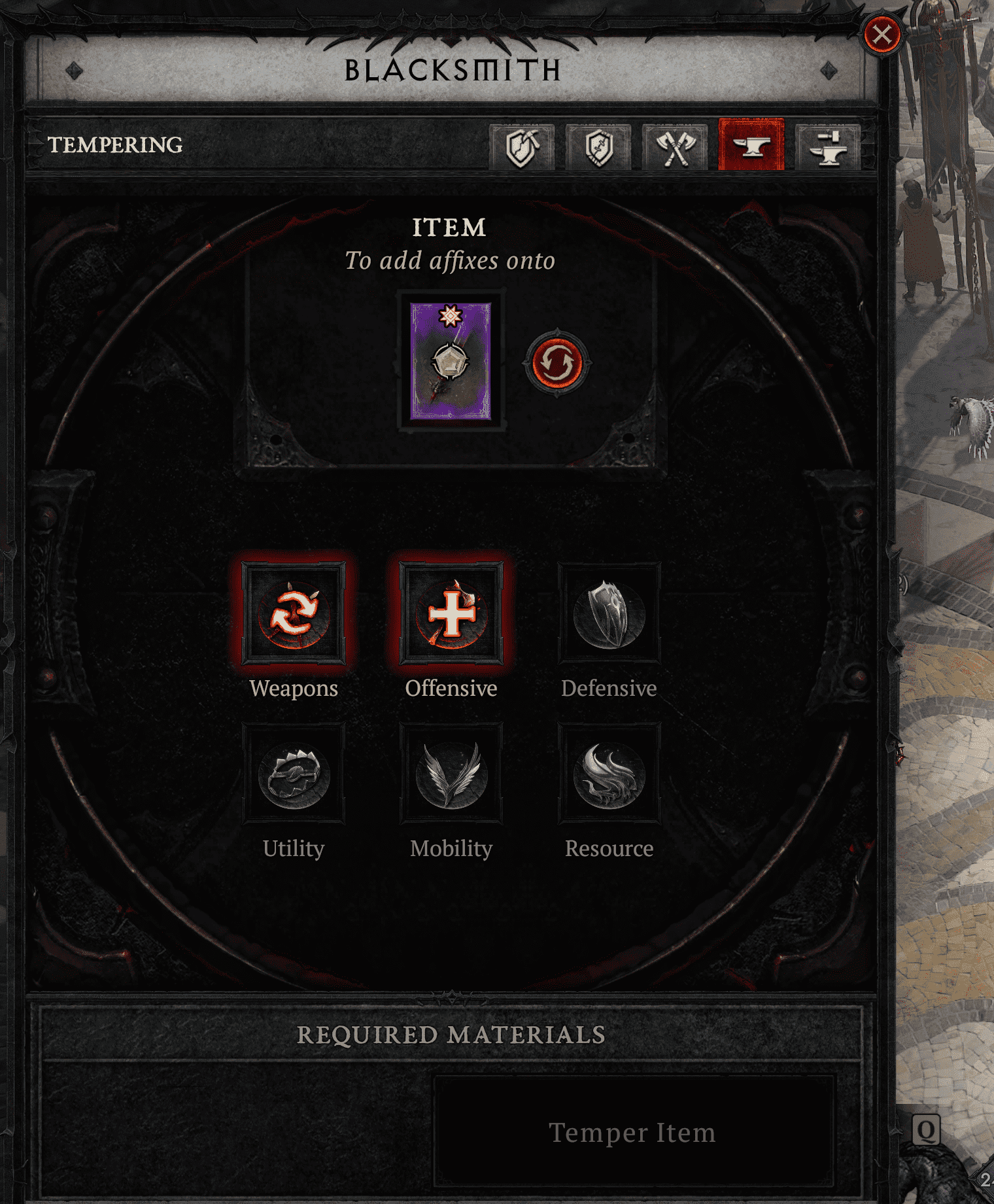
Tempering is an in-game mechanic in Diablo 4 where you can add specific affixes to your gear, provided that you have the necessary materials. You can temper your items by visiting the Blacksmith and clicking on the second-to-the-last icon (before Masterworking).
Here are some quick facts about Tempering that you should know:
- You can temper just about any item in the game, so long as it is at least of Rare quality (yellow name).
- Both Non-Ancestral and Ancestral Items can be tempered, but the required items are different to initiate the process.
- You need Temper Manuals in order to unlock affixes on the Blacksmith.
- Each class in Diablo 4 has a different set of Temper Manuals.
- If you are tempering an Ancestral Item, you can actually reroll multiple times to achieve a GA (aka Greater Affix). Items have a set amount of Temper Charges (anywhere between 1 and 5). When these are exhausted, you need a Scroll of Restoration to reroll once more.
- You can only temper one affix on your gear.
Temper Manuals and Affixes
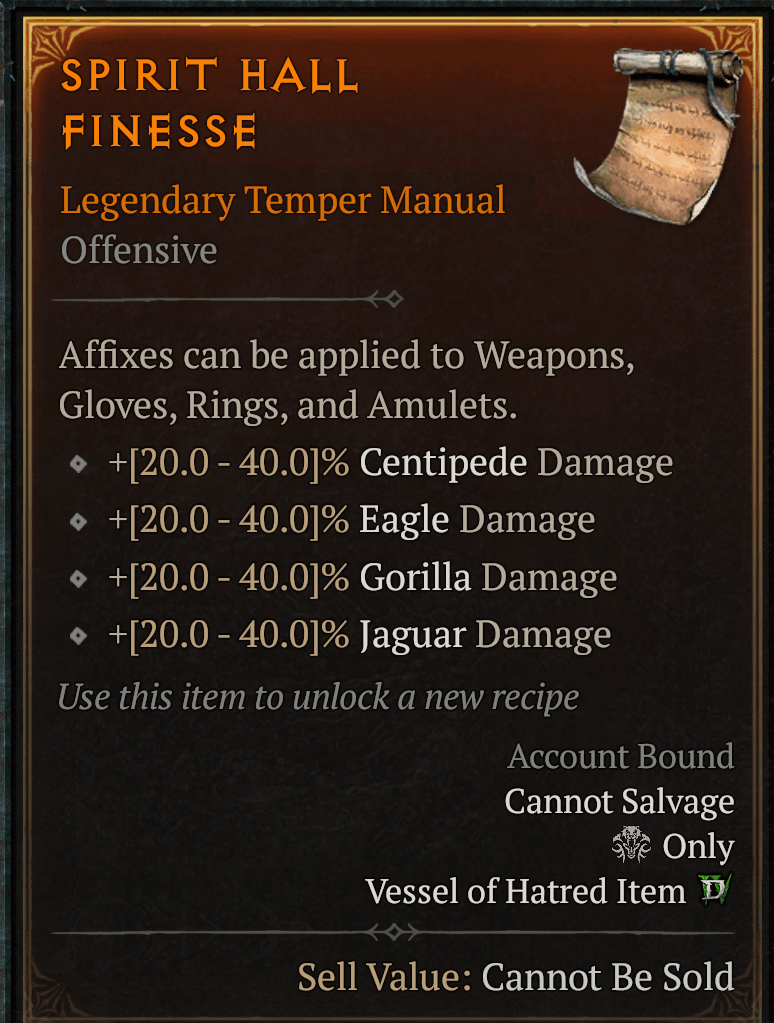
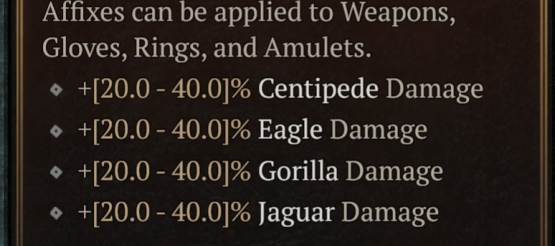
A Temper Manual is a consumable item in Diablo 4 that teaches the Blacksmith a specific set of affixes when used. After doing so, you can now have those affixes tempered on the relevant items. In the image above, you see a Temper Manual that adds up to 40% damage for Centipede, Eagle, Gorilla, and Jaguar skills for the Spiritborn. These affixes can be applied to weapons, gloves, rings, and amulets.
That said, where do you get Temper Manuals? Well, Temper Manuals can be acquired from the following sources:
- Tree of Whisper caches
- Helltide Chests
- Nightmare Dungeon boss loot
- War Bounty from Nightmare Dungeon (War Plan Node)
- Undercity Loot (after defeating the District Boss)
If you are going to create an alt character, save up some Tree of Whisper caches using your main character. After that, simply log in to your alt character and open up the caches. This is one of the easiest ways to get Temper Manuals on your subsequent characters in Diablo 4.
Tempering Categories
There are six different Tempering categories in D4, namely:
- Weapons
- Offensive
- Defensive
- Utility
- Mobility
- Resource
Not all of those categories are applicable to all types of gear. For instance, you can only temper affixes from the “Weapons” and “Offensive” categories on your weapons.
Here is a complete list of gear types and the affixes that you can temper onto them:
| Gear Type | Temper Categories Available |
|---|---|
| Weapons | Offensive Weapons |
| Helmets | Defensive Utility |
| Chests | Defensive Utility |
| Gloves | Offensive Utility |
| Pants | Defensive Utility |
| Boots | Mobility Utility |
| Off-Hand | Offensive Weapons |
| Shield | Defensive Utility |
| Rings | Offensive Resource |
| Amulets | Offensive Defensive Utility Mobility Resource |
As you can see, only amulets can have a wide range of affixes that come from Tempering in Diablo 4. Thus, it is one of the most versatile item slots as far as Tempering is concerned. You can temper whatever affixes your D4 build needs to reach its maximum potential.
Rerolling Tempered Affixes
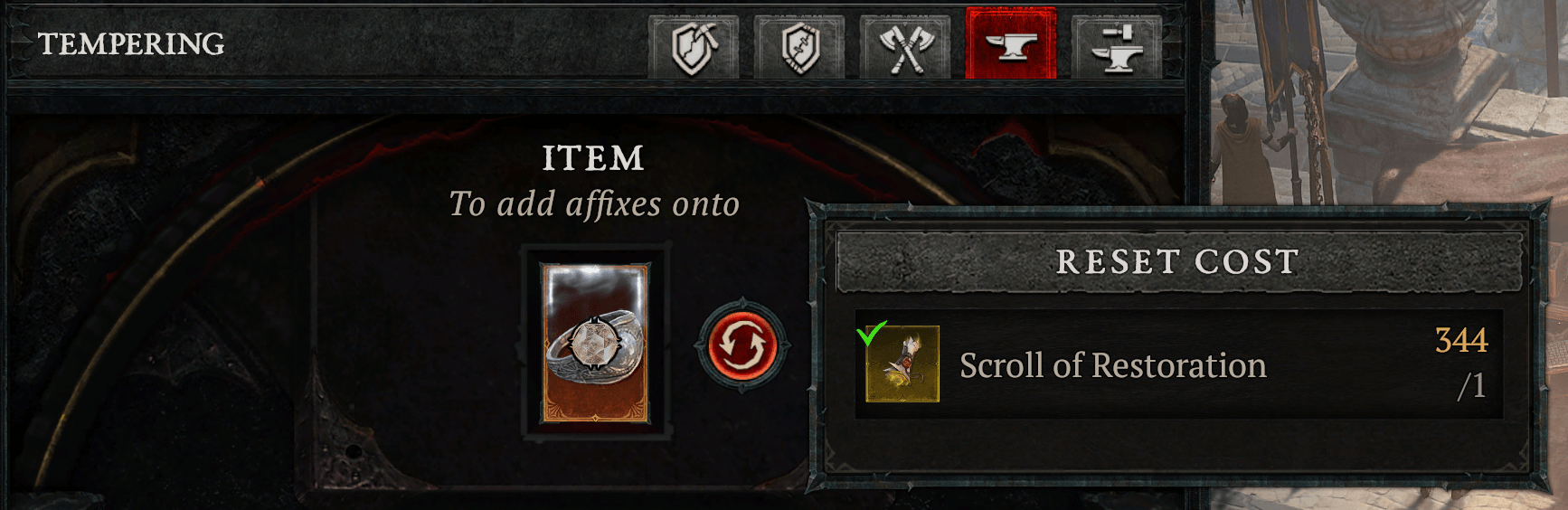
Each tempered affix can roll in ranges (minimum to maximum), so you might have to reroll the affix until you get the number that you want. You can reroll the tempered affix as many times as needed. Items have an initial set of Temper Charges, but you need a Scroll of Restoration for every subsequent attempt after those have been exhausted.
You can get a Scroll of Restoration in Infernal Hordes, though the Artificer’s Pit and the Undercity are not bad if you do them in higher Torment Difficulties. You can refer to our D4 War Plans Guide to find the best nodes for these activities to maximize loot.
Required Tempering Materials
Although Temper Manuals are important for Tempering, you need to have some raw materials to actually do the process as well. Here is a breakdown of what you need for Tempering in Diablo 4:
| Item Type | Materials Needed |
|---|---|
| Rare/Legendary/Unique Armor (Non-Ancestral) | 25 Rawhide 10 Veiled Crystals |
| Rare/Legendary/Unique Weapons (Non-Ancestral) | 50 Iron Chunks 20 Veiled Crystals |
| Rare/Legendary/Unique Rings and Amulets (Non-Ancestral) | 25 Iron Chunks 10 Veiled Crystals |
| Ancestral Legendary/Unique Item | 25 Forgotten Souls |
The Rawhide can be obtained by salvaging armor, while the Iron Chunks are from weapons. Veiled Crystals can be gotten from rare items (armor, weapons, and jewelry).
On the other hand, Forgotten Souls are acquired by salvaging ancestral gear. Since Normal, Magic, and Rare items can be ancestral now in Diablo 4, salvaging them will yield some Forgotten Souls.
If you want to acquire a boatload of these materials, you can run a Nightmare Dungeon with a “Materials Reserve” affix. Just make sure to open the chests while you are inside.
Best Items to Temper First in Diablo 4
The answer to the question of which item in D4 you should temper first is actually quite easy. It is always a good idea to temper your weapons first because they provide the most bang for the buck in terms of improving your damage output.
Once those are settled, the next item to temper is a unique item that is mandatory for your build to work. In the case of the Whirlwind Barbarian, you should temper Gohr’s Devastating Grips to add Critical Strike Damage or other affixes that you want for the said build.
After that, go for your jewelry. In most cases, you temper either cooldown reduction, critical strike damage, or critical strike chance on your rings and amulets, depending on the build you are running.
When you have tempered the above-mentioned items, you can then proceed with your other pieces of gear, starting with the body armor, followed by the helmet, pants, and boots.
So, to put it simply, temper the following items first:
- Weapons
- Mandatory unique item for your build
- Jewelry (Amulet and then rings)
- Other pieces of gear
D4 Tempering vs. Masterworking: What is the Difference?
Both Tempering and Masterworking are item upgrading mechanics in Diablo 4, though they vary in scope. If Tempering lets you add a specific affix to your item, Masterworking improves the item’s base stats, as well as upgrades a random affix into a greater affix.
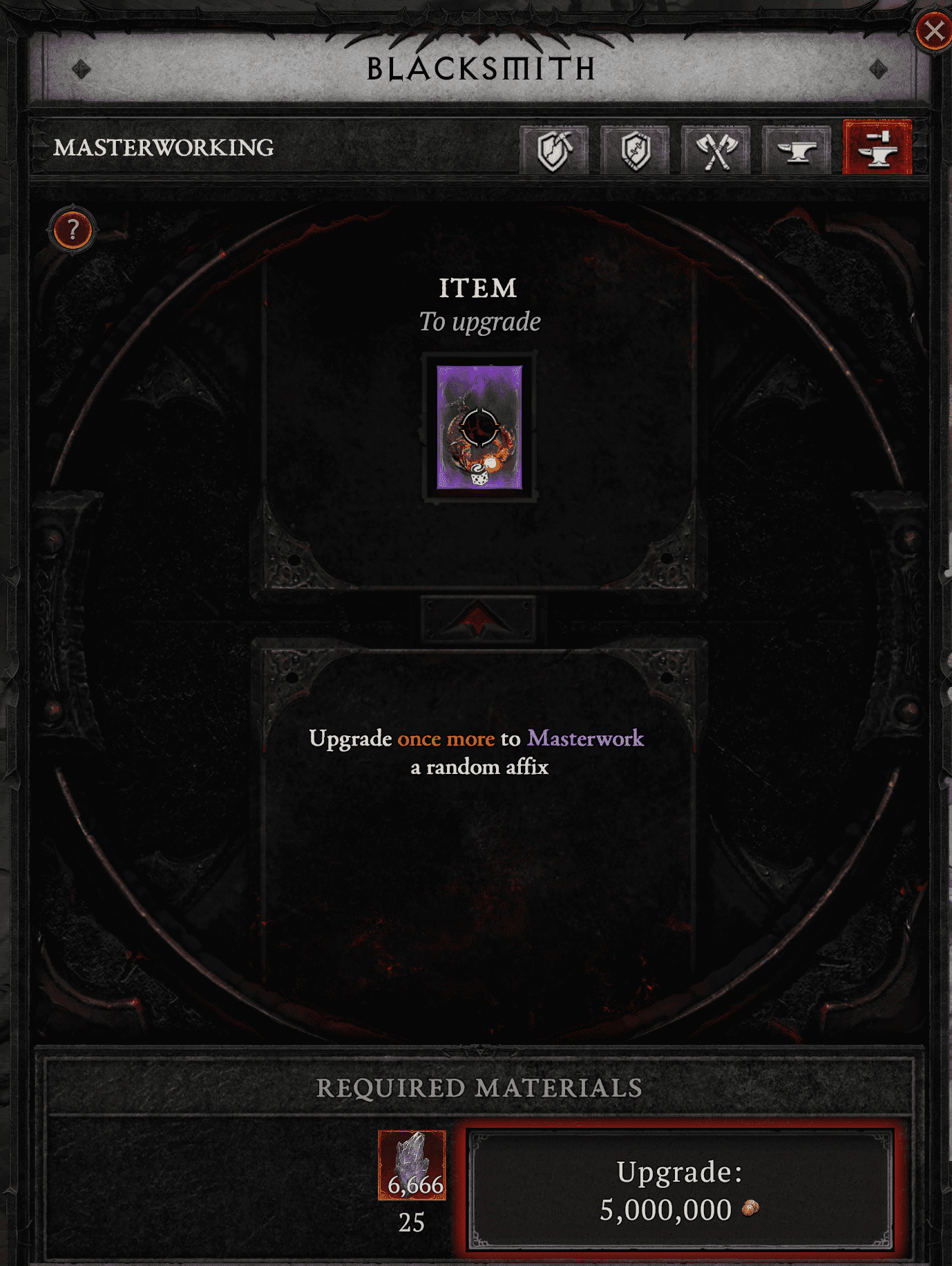
If you are not satisfied with the affix that is upgraded into GA, then you can reroll by spending 10 million gold, 200 Obducite, and 1 Neathiron.
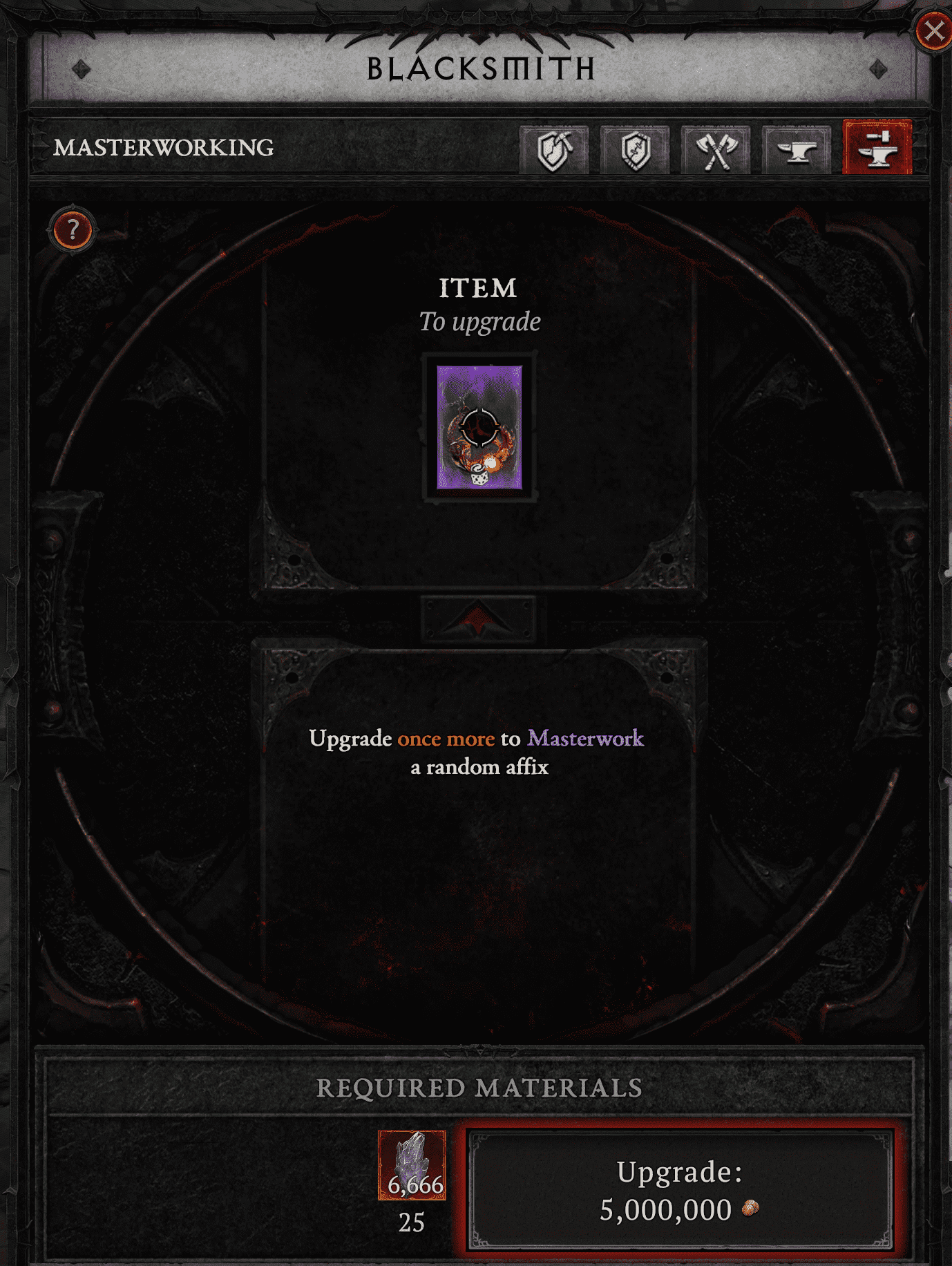
The capstone upgrade (when fully masterworked) for your item can actually be the affix that you have tempered. So, if you want that to happen and it does not hit on the first try, you can reroll as many times as needed. You just have to have the necessary materials.
Common Tempering Mistakes to Avoid
Tempering is a very forgiving mechanic because you can simply reroll as many times as you want. However, there are some common mistakes that you should avoid, especially if you want to save some materials. These are:
Wasting Materials on Non-Ancestral Gear
You can temper pretty much any item in Diablo 4, and it’s highly encouraged whether you are leveling up or well into the endgame. However, you should not waste your materials on Non-Ancestral Gear because the tempered affix cannot be upgraded to a Greater Affix (GA).
So, if you are still wearing Non-Ancestral gear, simply add whatever tempered affix that your build needs, and then move on. Save your materials for whenever you have an Ancestral variant of your currently equipped item, and proceed with the Tempering to GA.
Not Salvaging Useless Gear
Every time you temper an item, you need to have the basic ingredients to initiate the process. Some of the materials, such as Iron Chunks, Veiled Crystals, and Rawhide, can be obtained by salvaging rare armor and weapons.
If you are still new to the season, don’t forget to loot and salvage whatever gear you can find. This is so that you will have enough materials for upgrades later down the line.
Not Having Backups
This is a common rookie mistake in Diablo 4. Not having backups when upgrading gear can severely hamper your build if you don’t have extras to fall back to.
When you temper your gear and have GA’d the required affix for your build, the next logical step would be to Masterwork it. After getting the capstone upgrade, the final step will be to transfigure it using the Horadric Cube. The process of Transfiguration is permanent, so if the transfigured affix is useless for your build, you end up with a dud.
Hence, it is always a good idea to have a backup before proceeding with the complete suite of upgrades (Temper, Masterworking, Transfiguration).
Spending Scrolls of Restoration on Non-Ancestral Gear
Wearing Non-Ancestral gear is quite common in the early days of a new D4 season. However, you should never spend your Scrolls of Restoration on Non-Ancestral items, due to the fact that the tempered affix cannot be upgraded into a Greater Affix.
If you must upgrade, only use the available rerolls on the item itself (typically 1-3, depending on the item). Once they have been exhausted, then settle with the upgraded affix.
Only spend your Scrolls of Restoration on Ancestral Legendaries, Uniques, and Mythic Uniques.
Not Farming for Tempering Recipes
The prevalence of Temper Manuals has improved in the current season of Diablo 4. However, not a lot of players know exactly where to find them.
Frequently farm Helltides, the Undercity, and Nightmare Dungeons. Every time you defeat the boss, you will have a higher chance of obtaining a Temper Manual. Additionally, opening Tree of Whisper Caches is a great way to complete your Temper Manuals for the season.
Current Season Notes
In the current season, you can now temper unique items and Mythic Uniques. This was not possible in the prior seasons, so it is definitely a huge change.
Additionally, “Mythic” is now a modifiable item quality, wherein a unique item may drop as a Mythic Unique and are always Ancestral. Besides that, the Heir of Perdition, Ring of Starless Skies, The Grandfather, and other Mythic Uniques in the past are now known as “Iconic Mythics” or “Iconic Mythic Uniques.”
When an item is of Mythic quality, any tempered affix is always guaranteed to be a maximum roll. However, you still need to reroll a number of times for that affix to be upgraded into a Greater Affix.
The same rule applies here: only waste your tempering materials on Ancestral Uniques or Mythic Uniques, so that you get a Greater Affix out of this process.
FAQ
How Do I Unlock Tempering in Diablo 4?
Tempering is already available right from the beginning. However, you need to acquire Temper Manuals to teach the Blacksmith the ability to add certain affixes to your gear.
Can I Reroll the Tempered Affix?
Yes! You can reroll the tempered affix as many times as you want, so long as you have enough Scrolls of Restoration.
Rerolling the tempered affix is highly encouraged, especially if you have Ancestral Legendaries, Uniques, and Mythic Uniques. This is because these items can have a tempered Greater Affix.
Is it Possible to Temper a Unique or Mythic Unique Item?
Yes. That is actually part of the Mythic 3.0 system implemented in the current season of Diablo 4.