


D2R Stash Management: Tips for Organizing Your Items without Extra Tabs
16.01.2026 - 04:09:50
Diablo 2: Resurrected , Game Guides

Diablo II was one of the ARPGs that paved the way for others to follow suit. Now we have Path of Exile, Path of Exile 2, Last Epoch, and Diablo IV. All of them were inspired by what Diablo II has put forth, and they addressed some of the game’s pressing issues, chief among them being the lack of stash space.
In PoE 1 and PoE 2, for example, you can buy as many stash tabs as you like, provided that you are willing to spend some money in order to do so. Diablo IV does not have this option (hopefully, it will be included in the future), but the game does provide you with several stash tabs to work with.
But Diablo II: Resurrected? Even the remastered version of the game has not addressed one of its common complaints. For a game that provides a lot of amazing D2R items, it definitely does not give you avenues to increase your stash space.
So in this article, I will give you some handy tips on how to organize your items in the game without requiring additional stash tabs. You will learn what items to keep and what items you can safely feed Charsi with. Whether you are a seasoned veteran, a returning player, or a complete beginner, I am here to help you!
Understanding D2R’s Stash Limitations
As mentioned earlier, other ARPGs allow you to get as many stash tabs as you need. Unfortunately, that is not the case with Diablo II: Resurrected.
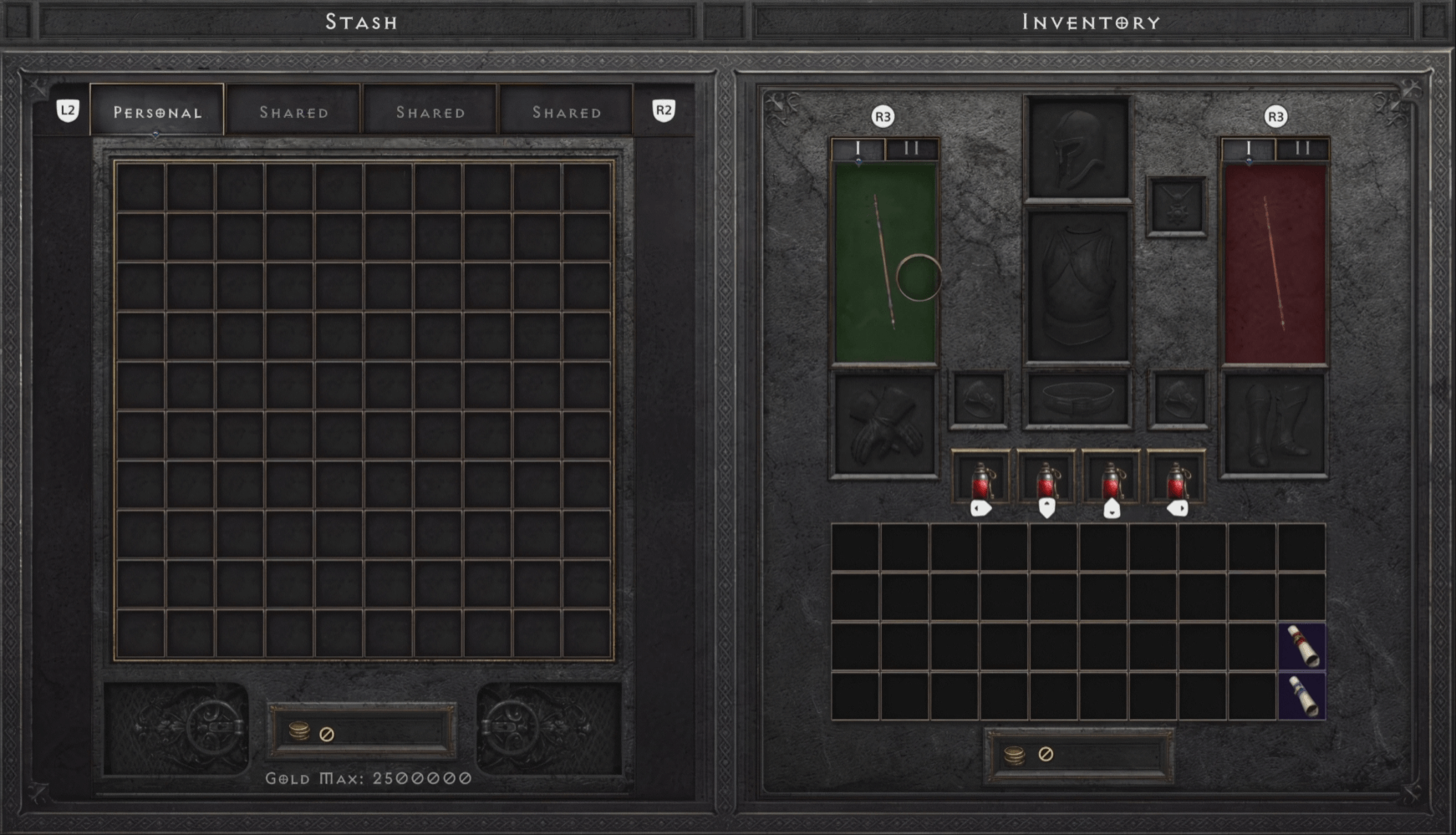
You see, you only have a total of four stash tabs in D2R. One is your personal stash tab, which is a space that is dedicated to each and every one of your characters. If you create a Barbarian now and then proceed to make a Necromancer in the future, then the Necromancer will have a personal stash of its own.
The other three stash tabs are considered “Shared” inventory spaces. This is because the items that you put here can be taken by any of your characters. The idea behind this is that you can create a dedicated speedfarming build in Diablo II: Resurrected, and whichever endgame item you farm with it can be placed in the shared stash tab for your other builds to use.
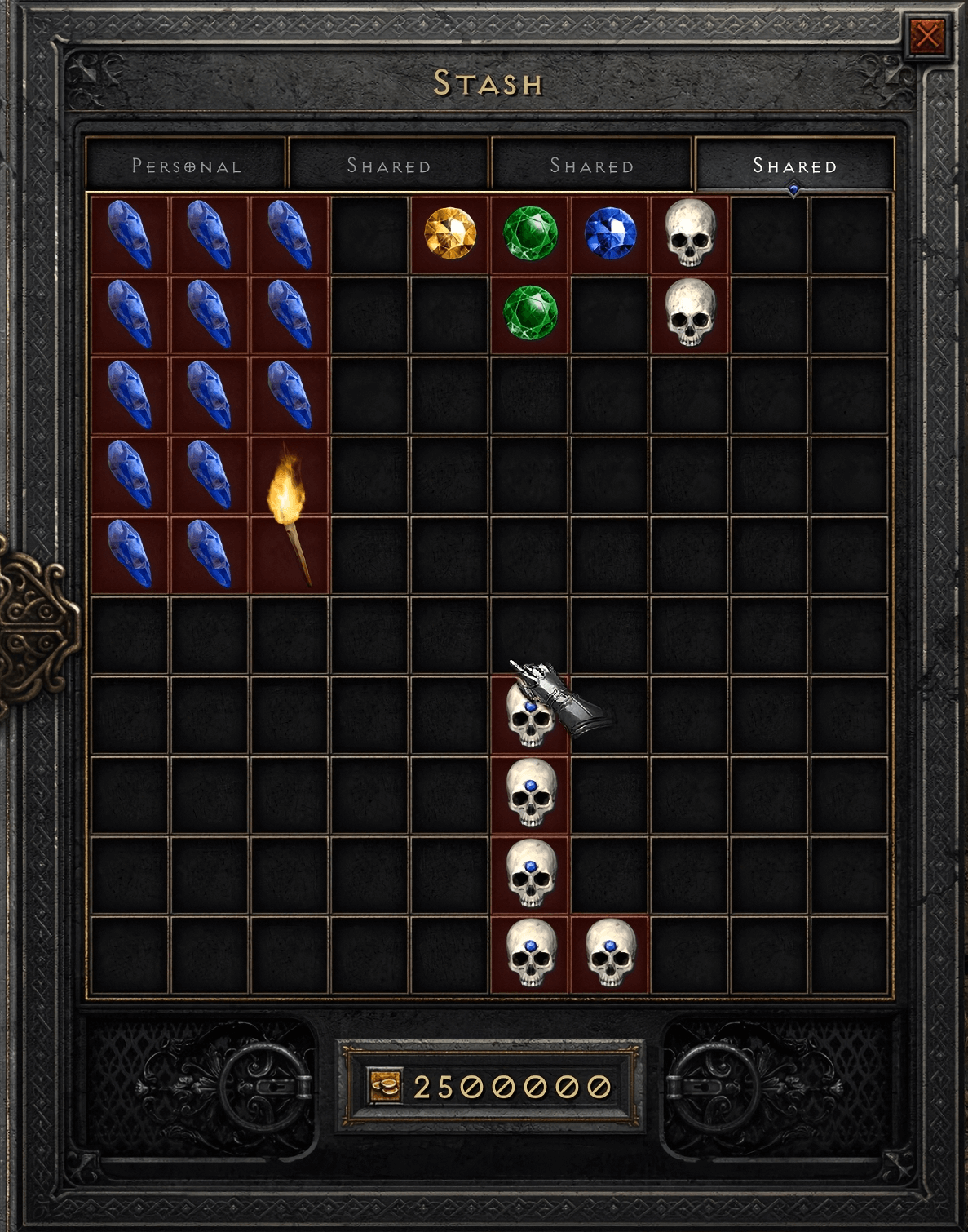
Now, here’s the problem: There is no real way of increasing those stash spaces at all. This means that you generally have only four stash tabs to work with, which is quite a pain, considering that common items like D2R runes and jewels of the same type do not stack. This causes you to lose so much space, especially if you are thinking of farming those rare runes like Ist, Ber, and Jah!
Blizzard has kind of addressed this by providing three additional stash tabs. The problem? They are currently only available in China. While there was an update released in early December of last year, it was solely to match the version number of the Chinese port with the Global version of the game. In other words, players on the international edition do not have access to those extra stash tabs!
So, what can be done about that at this point? Well, Blizzard has announced that a huge content update is coming for Diablo II: Resurrected as part of the 25th anniversary of the original. If you want to know more about it, you can read our 25th anniversary update article to get the latest scoop.
Core Principles of Effective Stash Management
Since you only have a limited amount of stash space to work with, you need to change your mindset when it comes to storing items in Diablo II: Resurrected.
Here are some of the core principles of effective stash management that you should keep in mind when playing this ARPG:
Use One Build to Start
If you are still going to create your very first character in D2R, then you should think about it for the long term. What I mean by this is that sticking to a particular build will force you to only keep items that are appropriate for your character.
For example, if you are going to play the Mosaic Assassin, only keep items like Greater Talons with the Mosaic Runeword, Enigma, Griffon’s Eye, and Stone of Jordan. This way, you will narrow down the items that you have to stash, while you put the others as “Charsi Food.”
Now, you are probably wondering when you can safely create a build. To be clear, you can try out as many builds as you can in Diablo II: Resurrected. However, this first tip is just to help you make sure that you have enough storage space to earn gold and other valuable items before you make another character.
Items Are “Temporary”
In Diablo II: Resurrected, you can equip your character with set items, uniques, and a wide variety of runewords. The Death’s Guard, for example, is a set item that prevents you from being frozen. This, of course, is a very good leveling item since you can wear it as early as level 6, but only up to a certain point. Once you get your hands on something better, such as the String of Ears or the Arachnid Mesh, the Death’s Guard’s value diminishes significantly.
As soon as you get upgrades for your current gear, make sure to sell the ones that you no longer need. The only acceptable reason to keep them is if you are planning to create a new character (or a set of new characters) later down the line.
Convert Loot Into Currency
What is your purpose for farming items in Diablo II: Resurrected? Is it to make sure that your builds are decked out with the best possible gear? Or, is it to gain access to highly coveted items and sell them for a profit? If it is the latter, then you should be aggressive with trading in D2R and convert loot into currency as soon as you find yourself lacking stash space.
You can go to some trade websites like Diablo2.io or Traderie, where you can sell various runes in bulk to other people. There are also some Discord Servers that allow you to do the same thing, though you have to be more wary about who you trade your items with. If you are going the Discord route, make sure to vet the other person before initiating the trade, just to be safe.
As to what items you should trade to other players, do not worry. I will go over the things that are highly tradable later in this guide, so be sure to read it to completion!
Organize Your Stash
Each stash available to you in Diablo II: Resurrected is presented in a 10x10 grid, meaning you have about 100 slots at your disposal. The problem, though, is that some items fill eight slots (like the Bardiche), while others only populate one or two grids (like the small and large charms).
With that said, you should spend some time organizing your stash space so that it will be much easier for you to discern which items are for keeps and which ones should be sold to other players.
For instance, you could dedicate the “Personal” stash tab for unique items, while the “Shared” stash tabs are for runes and perfect jewels. It is up to you how you go about it, but organizing your stash tabs is definitely something to consider when it comes to stash management in Diablo II: Resurrected.
Use ‘Mules’ to Store Additional Items
You may have heard of the term “mule” being used in Diablo II: Resurrected, and you are probably wondering what it is exactly. Mule, in this context, is another character in your account that is specifically made to store valuable items.
If you can recall, I mentioned earlier that each character that you make has its own personal stash tab. This also means that every character has its own personal inventory, so you actually have two storage spaces at your disposal. That is why creating a lot of mules is a great way to address the longstanding issue of stash space in D2R.
Here is some general information that you need to know about mules in Diablo II: Resurrected
- “Muling” is a useful strategy when it comes to stash management in this game.
- Due to the severe limitation in stash space, players are forced to create new characters for the sole purpose of storing items.
- This strategy has been done since the early days of the original Diablo II. Sadly. It is still the case in D2R.
- Some players have been clamoring for Blizzard to add new stash tabs. Hopefully, this will be done in the 25th anniversary update, releasing later this year.
The reason why muling is still relevant in Diablo II: Resurrected is that Blizzard still has not implemented measures to improve the quality of life, particularly in this aspect. While the company has already added a few stash tabs for the China Region of the game, those three stash tabs are non-existent in the global version.
If Blizzard is capable of adding more stash tabs, then it is not too far-fetched to assume that they will come at some point in the future. Only time will decide whether the company does something about stash management as part of the 25th anniversary update or not.
Anyway, you can create up to 20 characters on your account. Even if 10 of those are reserved for different builds, there are still 10 that you can use to store your endgame gear, such as Enigma, Infinity, and so much more!
How to Know the Value of Items in D2R?
If you are new to Diablo II: Resurrected, players trade for valuable items using runes as currency. For example, a single Stone of Jordan ring costs around three Ist Runes or a single Cham Rune.
To know the value of items, I highly recommend that you visit Traderie. This is a platform that most D2R players use to trade for highly coveted items. Once you arrive on the platform, use the search bar at the top to find the item that you need. Click on the item, and it will show you a bunch of people who have it, along with the price.
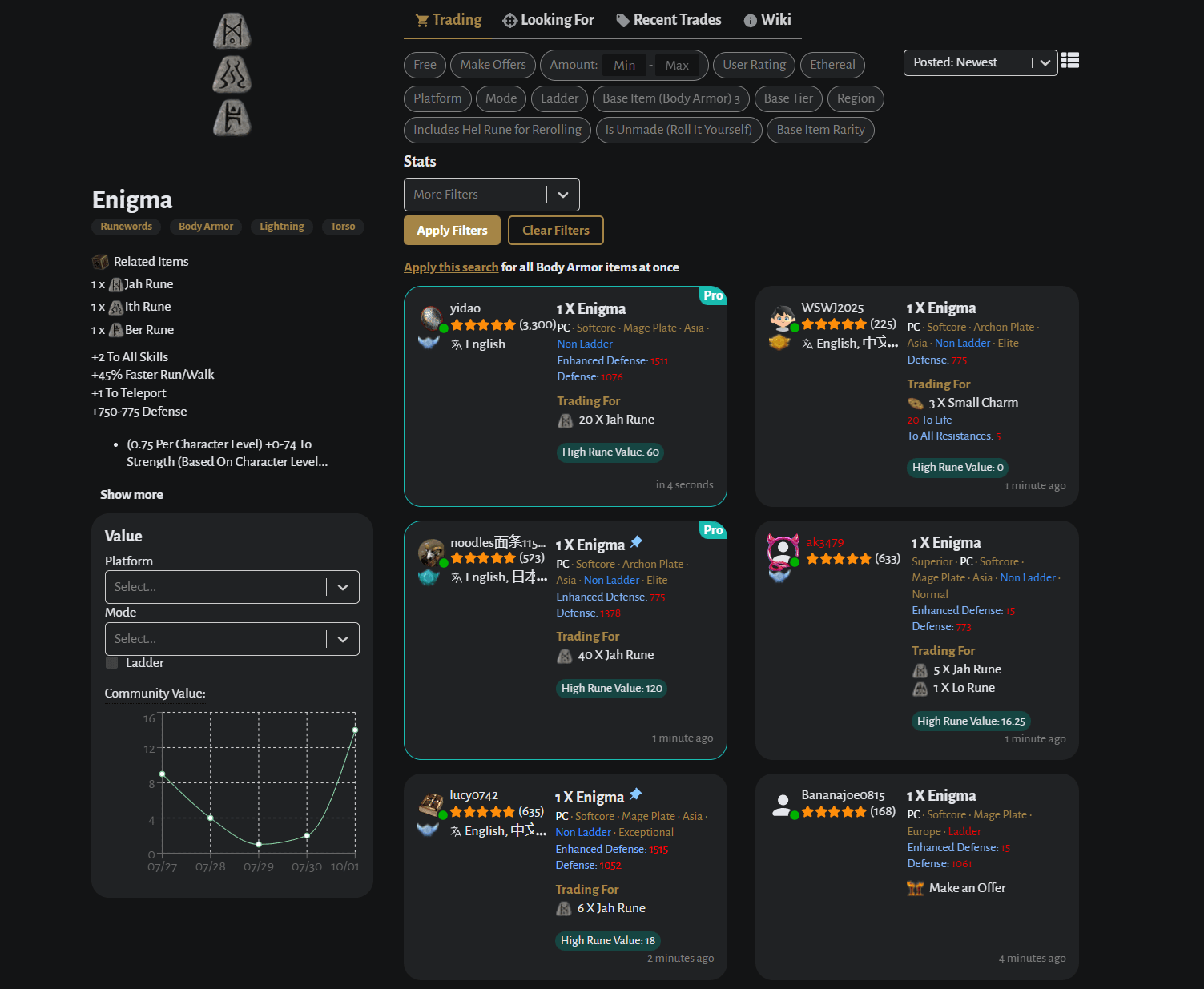
If you are curious if the freshly farmed unique item that you have is of any value, simply use the search functionality on Traderie to give you an idea.
What Items to Keep
Okay, so I have provided you with some core principles and how you can know the value of your items. The next part is about what items you need to put into your stash, as well as those that you can safely sell or salvage for scraps.
As you now know, D2R runes are being used to trade for items in this game. However, the game has a relatively long list of runes available at 33 (at the time of writing). So, which ones are worth keeping? Here is a list of the most valuable runes in Diablo II: Resurrected, which you should keep:
Low Runes
Name of Rune | Notes |
Ral | -Highest rune that you can farm in The Countess (Normal). -Used as an ingredient for crafting a Caster Amulet or Blood Helm |
Ort | -Farmed from The Countess (Nightmare). -Recipe for crafting a Blood Weapon or Caster Gloves |
Sol | -Farmed from The Countess (Nightmare) -Primarily used for crafting Lore and Insight |
Amn | -Farmed from The Countess (Hell) -Mainly used for crafting Call to Arms -Also used to upgrade a rare weapon to its exceptional version |
Nef | -Farmed from The Countess (Normal) -Necessary for crafting Flickering Flame, Obsession, and Smoke |
Ith | -Farmed from The Countess (Normal) -Used for crafting Enigma, Mist, and Harmony |
Tir | -Farmed from The Countess (Normal) -Necessary for crafting Beast, Grief, and Insight |
Tal | -Farmed from The Countess (Normal) -Used for upgrading a set/unique armor into its exceptional variant -Also utilized as an ingredient for Spirit, Stealth, and Insight |
Thul | -Farmed from The Countess (Hell) -Necessary for crafting Treachery, Heart of the Oak, and Spirit |
Hel | -Farmed from The Countess (Nightmare/Hell) -Used for Breath of the Dying, Myth, and Obedience |
High Runes
How about the high runes? If these drop for you, make sure to put them in your stash:
Name of Rune | Notes |
Lem | -Can be farmed from The Countess (Hell), though some people have more success cubing it along with a Flawed Ruby and three Fal Runes -Used for crafting Treachery and Faith |
Pul | -Used primarily for upgrading exceptional items into their elite variants -Also utilized for crafting the Heart of the Oak, Flickering Flame, and Gloom |
Um | -An ingredient for the Horadric Cube recipe that allows you to upgrade an exceptional weapon into its elite variant -Used for crafting Chains of Honor, Duress, and Plague |
Gul | -Used for crafting some valuable runewords, such as Mist and Mosaic |
Vex | -Considered as the first “true high rune” among the runes available in the game -Used for crafting Breath of the Dying, Heart of the Oak, Flickering Flame, and Phoenix |
Lo | -A staple for melee characters because it is used as an ingredient for crafting Grief, Fortitude, and Phoenix |
Ist | -The most widely used rune for trading items in D2R -Used as a metric for pricing valuable stuff in the game as a result -Part of the reason why it’s so incredible is that it provides a 25-30% boost in Magic Find, depending on where you insert this particular rune into -Also utilized for crafting Chains of Honor, Call to Arms, and Infinity |
Mal | -Mal’s trade value is almost on par with Ist -Part of the reason why is due to the Mal Rune being a core component of some worthwhile runewords, such as Oath, Infinity, and Last Wish |
Cham | -A very useful rune in its own way, inserting a Cham Rune into a shield or armor prevents you from being frozen -Also utilized as a key ingredient for Mist, Plague, and Pride |
Ber | -A very rare rune that is used for crafting some of the best runewords in the game, including Chains of Honor, Infinity, and Enigma |
Jah | -Another valuable rune, the Jah Rune is used for crafting Enigma, Faith, Dream, and Last Wish -This is quite rare, with veteran players stating that they have not seen the Jah Rune drop despite years of playing the game |
Zod | -The highest rune available (and also the rarest) -Grants the “Indestructible” mod, alleviating the need for repairs -A core component of Breath of the Dying and Obsession |
Unique Items
- Helmets
- Griffon’s Eye
- Harlequin Crest (aka “Shako”)
- Vampire Gaze
- Arreat’s Face
- Andariel’s Visage
- Body Armor
- Skin of the Vipermagi
- Skullder’s Ire
- Ormus’ Robes
- Weapons
- The Oculus
- Eschuta’s Temper
- The Reaper’s Toll (Ethereal)
- Wizardspike
- Titan’s Revenge
- Shields
- Herald of Zakarum
- Stormshield
- Homunculus
- Gloves
- Magefist
- Dracul’s Grasp
- Chance Guards
- Belts
- Thundergod’s Vigor
- Verdungo’s Hearty Cord
- Razortail
- Arachnid Mesh
- Boots
- Sandstorm Trek
- War Traveler
- Gore Rider
- Rings
- Stone of Jordan
- Bul-Kathos’ Wedding Band
- Raven Frost
- Dwarf Star
- Amulets
- Mara’s Kaleidoscope
- The Cat’s Eye
- Highlord’s Wrath
Set Items
- Tal Rasha’s Wrappings (Sorceress)
- Armor, amulet, belt
- Tran-Oul’s Avatar (Necromancer)
- Gloves, belt, helm
- Orphan’s Call
- Guillaume’s Face (yes, just the helmet)
- Immortal King (Barbarian)
- Helm, belt, gloves, boots
- Miscellaneous
- Aldur’s Advance
- Natalya’s Soul
- Laying of Hands
I hope that you’ve found this guide helpful! For more updated D2R guides, visit our RPGStash Blog.